


What happens after we hand over

The lock-in rarely looks like a contract. It looks like an account in someone else’s name, and you find it the day you try to leave.
3 min readAnswers “Will I be stuck depending on them?”
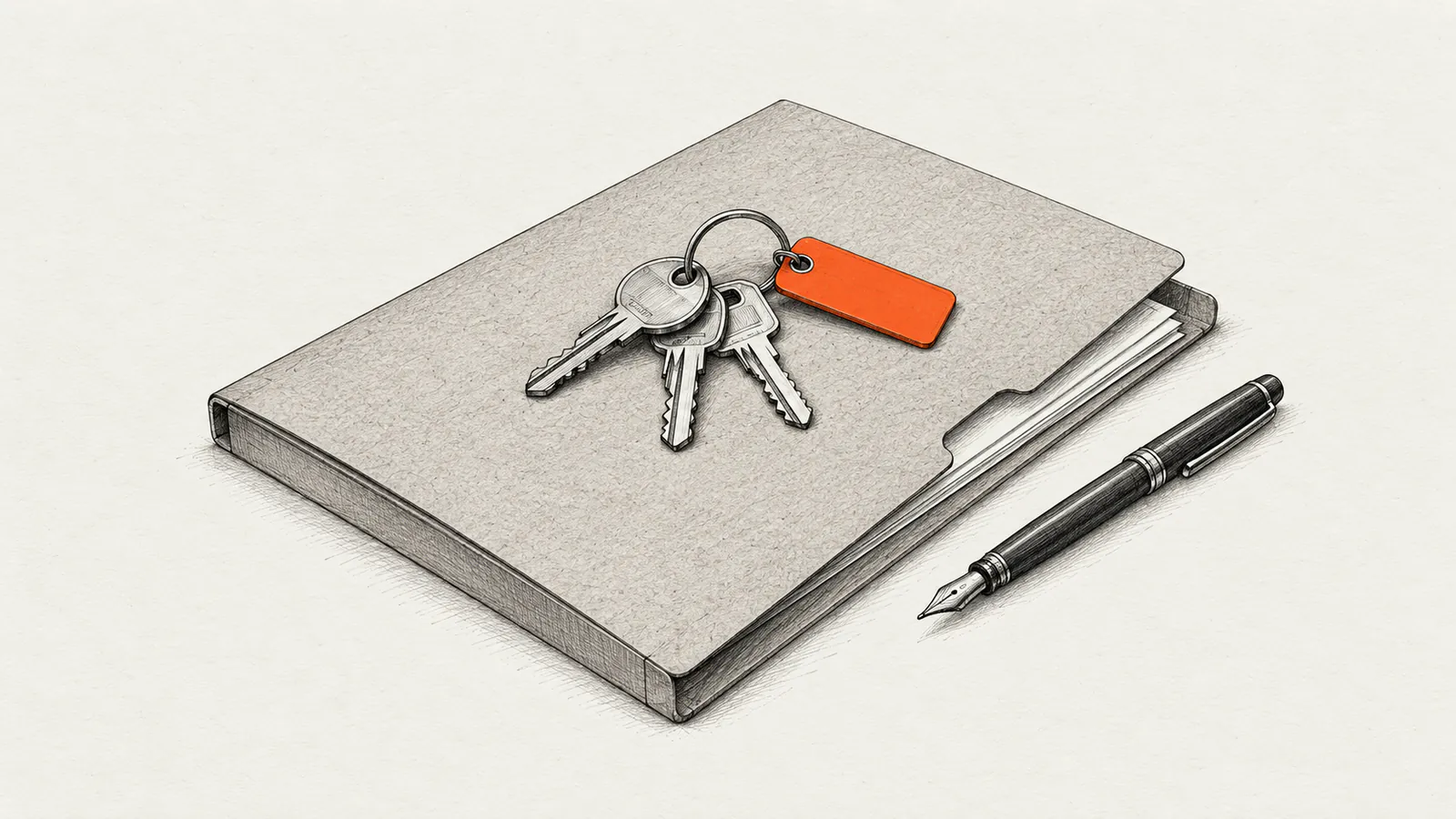
A pencil drawing of a set of keys with an orange tag resting on a document folder, a fountain pen beside it.

Most people asking this question have been burned, or know someone who has. The story is always roughly the same: the site was fine, the relationship went cold, and then it turned out the domain was registered to the agency, or the site ran on a platform only they could edit, or nobody could find the login for the analytics account. The site was never really theirs. They were renting it without being told.

What "handover" usually means

Often, nothing. It is a word in a proposal that describes an email at the end of a project. A real handover is a transfer of specific things, each of which either happened or did not, and you can check.

What should change hands

Domain
Your registrar account
Registered in your business name, paid by you, on a login only you hold.
Hosting
Your account
Whether it is Shopify, a host, or a platform — the account is yours, and the card on it is yours.
The site itself
Yours to move
Built on something standard enough that another developer can pick it up without a rewrite.
Content and images
Original files
Not just what is live on the site — the source files, at full size.
Analytics and accounts
Your logins
Search Console, analytics, the business profile. If someone else owns the history, you cannot take it with you.
Customer data
Exportable
Your customer list, orders and enquiries, in a format that opens somewhere else.

Four lock-in patterns, and how to spot them

None of these are usually malicious. They are what happens when nobody writes the question down at the start. They are still your problem later.

  • The account in their name. The domain, the hosting, or the Google Business Profile sits under an agency login. Ask whose email address is on each account, and ask now rather than at the end.
  • The proprietary platform. The site runs on something the agency built and only they can edit, often sold as an advantage. Leaving means rebuilding from scratch, which is exactly the point.
  • The mandatory retainer. Support is bundled into a monthly fee you cannot decline without losing something you need — hosting, updates, or the ability to change your own prices.
  • The content you cannot edit. Every text change is a support ticket. This one is easy to test before you sign: ask to be shown, on screen, how you would change a price yourself.

A contract term is the honest version of lock-in. At least you can read it.

What ours looks like

Three commitments, and they are the same three printed on our pricing page, because they should not change depending on which page you are reading.

Ownership
Everything, in your name
Every account and file is in your name, handed over in full.
No lock-in
No term, no platform
No contract term and no proprietary platform holding your content.
Support
Optional
Ongoing help is optional: hosting, a care plan or monthly SEO, never a condition of the build.

In practice handover is a short session at the end where we sign you into each account, show you the content editor, and have you change something yourself while we watch — because a walkthrough you did not drive is a demonstration, not a handover. After that, errors we caused are fixed free for thirty days, and anything else is your call to make.

What to settle before you sign

  • Get the ownership position in writing, per account, not as a sentence about "full ownership".
  • Ask what happens to the site if you stop paying a monthly fee. If the answer is that it goes down, that fee is not support.
  • Ask to see the content editor before the project starts, not at the end.
  • Ask whether the build uses anything only that agency can maintain, and get the answer in writing.

None of this requires trusting anyone. That is the point — the whole question stops mattering once the answers are specific and written down.

The other notes

  • Answers “What does this cost?”

    What a website actually costs in Sydney

    Almost no agency will tell you before a meeting. Here is the range, what moves it, and the costs that never appear in the quote.

    · 4 min read

  • Answers “Do I need all this, or just a website?”

    Why reviews and your website are the same job

    A website answers a question the customer already had. Reviews are how they decide whether to ask it. Treating them as two purchases is how a good site gets no traffic.

    · 3 min read

Tell us what's broken.

Pick where it hurts. We'll tell you which stage is costing you money, then send a written scope and price.

  • No brief needed
  • A written scope and price
  • Yours to keep either way
Tell us what you're trying to fix0468 397 383